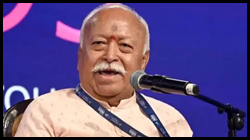
IOCUSA Warns Against RSS Ideology and Its Growing Clout in the US
Los Angeles/ Aug 30, 2026
NRIpress.club/ Ramesh/A.Gary Singh
The Indian Overseas Congress, USA (IOCUSA) expresses grave concern over
the American tour of RSS chief Mohan Bhagwat and the growing effort to present the Rashtriya
Swayamsevak Sangh (RSS) to American audiences as a benign cultural organization promoting “universal oneness” and civilizational dialogue.
The American public, particularly political, business, religious and civic leaders who may interact
with RSS representatives, deserves to understand the history, ideology and political
consequences associated with the organization.
The RSS cannot be evaluated merely by the carefully crafted language employed during an
overseas public-relations campaign. It must also be judged by its historical ideological record, its
conception of India as a Hindu Rashtra, the influence of Hindutva politics on the treatment of
religious minorities, and the increasingly polarized environment that has emerged in India.
An Ideology at Odds with India’s Constitutional Vision:
The India envisioned at independence was not a nation in which citizenship depended upon
religion. Jawaharlal Nehru championed a secular, democratic and scientifically minded republic
in which Indians of every faith could participate as equal citizens. Dr. B.R. Ambedkar gave
constitutional expression to that promise through guarantees of equality before the law, freedom
of conscience, religious liberty and protection against discrimination. That vision is
fundamentally incompatible with any political philosophy that defines the nation mainly through
the religion of its majority or relegates minorities to a subordinate cultural or political status.
Hinduism, one of the world's great and ancient religious traditions, must not be confused with
Hindutva political ideology. Millions of Hindus in India and throughout the world embrace
pluralism, democracy and peaceful coexistence. Our criticism is directed not against Hinduism
or Hindus, but against the political weaponization of religious identity.
The ideological history of the RSS and important figures in the Hindutva movement also
deserves serious examination. Writings associated with early Hindutva ideologues contained
deeply troubling discussions in praise of European ethnic nationalism and the treatment of
minorities in Nazi Germany. Such history cannot simply be erased by replacing the language of
majoritarian nationalism with contemporary slogans about harmony and universal brotherhood.
Minorities Have Paid the Price:
The consequences are not simply theoretical. Human-rights organizations, religious-freedom
monitors, journalists and civil-society groups have repeatedly raised concerns about
discrimination, hate speech, intimidation and violence affecting uslims, Christians and other
minority communities in India.
Churches and Christian organizations have reported attacks on places of worship, disruption of
prayer meetings, harassment and imprisonment of clergy and allegations that ordinary religious
activity constitutes forced conversion. Muslims have confronted inflammatory rhetoric,
Bulldozing of their residences, communal polarization and discriminatory treatment. Dalits,
Adivasis and other vulnerable communities continue to struggle for dignity and equality.
One of the most horrifying reminders of what religious extremism can produce was the 1999
murder of Australian Christian missionary Graham Staines and his two young sons, Philip, 10,
and Timothy, 6. Staines, who had spent decades serving people affected by leprosy in Odisha,
was sleeping with his children inside a station wagon when a mob led by Dara Singh, described
in contemporary reporting as a local Bajrang Dal activist, surrounded the vehicle and burned all
three alive. The atrocity remains an enduring warning about the deadly consequences that can
follow when religious minorities are portrayed as threats and hatred is allowed to masquerade
as nationalism.
The RSS may speak of “oneness” abroad, but genuine unity cannot be built by demanding
conformity at home. There is no meaningful democracy when the worth of citizenship is
measured by religious identity. There can be no credible message of national unity when
minorities live with fear that their faith, culture or patriotism will constantly be questioned.
IOCUSA is equally concerned that this ideological project is increasingly being internationalized:
Bhagwat's American tour should therefore not be viewed simply as another cultural visit by an
Indian religious or community leader. The RSS and organizations influenced by its worldview
have spent years cultivating relationships within diaspora communities, civic institutions and
political circles abroad. The United States must not become another battleground for importing
India's religious divisions. Religious majoritarianism does not become tolerant simply because it
crosses an international border or adopts the vocabulary of dialogue, culture and unity.
A Special Responsibility for the Indian American Diaspora:
IOCUSA is particularly troubled when some members of the Indian American community
promote majoritarian ideologies in the United States as enjoying the freedoms and protections
guaranteed by the American constitutional system. Many Indian Americans have proudly
become citizens of this country and sworn allegiance to the Constitution of the United States. That Constitution protects freedom of religion, equal citizenship, and the right of every individual
to worship or not worship, according to one’s conscience. There is a serious contradiction when
people benefit from those protections in America while supporting an ideological project that
critics say undermines comparable constitutional protections for minorities in India.
Indian Americans have prospered because America, despite its faults and continuing struggles,
has sought to build a society where a person's opportunities and citizenship are not determined
by whether he or she is Hindu, Christian, Muslim, Sikh, Jewish or belongs to no religion at all.
We should be strengthening those principles and not importing sectarian onflicts that can
divide Indian American communities, poison relationships among neighbors and transmit
religious hatred to future generations.
“We Must Not Import the Politics of Hatred”
“India belongs equally to the Hindu who worships in a temple, the Muslim who prays in a
mosque, the Christian who worships in a church, the Sikh who enters a gurdwara, and the
citizen who professes no religion at all. That was the promise of our Constitution, and no
organization has the right to rewrite Indian citizenship according to a religious test,” said George
Abraham, Vice-Chairman of the Indian Overseas Congress, USA.
“Dr. Ambedkar helped give India a Constitution founded upon liberty, equality and fraternity,
while Jawaharlal Nehru envisioned a modern, secular and pluralistic republic. Replacing that
vision with religious majoritarianism would radically change the character of the Indian
Republic.”
Mr. Abraham also warned of the danger of importing India's ideological conflicts into their
adopted homeland.
“We must not allow the politics of religious hatred to take root within our diaspora. It will divide
our temples, churches, mosques, gurdwaras, associations, neighborhoods and eventually our
children. Whatever our political differences, the Indian American community must not become
an overseas battlefield for groups aiming to polarize India along religious lines.”
American Institutions Should Exercise Due Diligence:
The seriousness of these concerns is highlighted by the United States Commission on
International Religious Freedom (USCIRF), the independent bipartisan U.S. government
commission created by Congress to monitor religious freedom worldwide. In its 2026 Annual
Report, USCIRF specifically recommended that the United States impose targeted sanctions
against individuals and entities, including the Rashtriya Swayamsevak Sangh (RSS), for what
the Commission described as their “responsibility and tolerance of severe violations of religious
freedom.” USCIRF recommended measures that could include freezing U.S.-based assets
and/or barring responsible individuals or entities from entering the United States.
That recommendation should be a wake-up call to American political leaders, business
executives and community organizations preparing to welcome RSS chief Mohan Bhagwat.
When a congressionally established U.S. commission identifies the RSS itself among entities
warranting consideration for targeted sanctions over severe religious-freedom violations,
Bhagwat’s visit cannot credibly be treated as an ordinary cultural or goodwill tour. American
institutions should ask why an organization facing such an extraordinary recommendation from
USCIRF is simultaneously being offered platforms, political access and legitimacy in the United
States. The contrast between the RSS's international message of “universal oneness” and the
record that prompted USCIRF';s recommendation deserves serious public examination.
The question is whether American institutions understand the ideology they may be legitimizing.
India's greatness has never rested upon the supremacy of one religion. It rests upon an
extraordinary civilization in which countless religions, languages, cultures and traditions have
survived and enriched one another.
The future of India must remain faithful to the constitutional promise of liberty, equality, fraternity
and equal citizenship, not religious supremacy. And the future of the Indian American
community must be built upon the same democratic principles that enabled our community to
flourish in the United States. We must not import the politics of division into America. We must
not weaponize religion. And we must never remain silent when supremacy is repackaged for an American audience and given the more respectable label of “universal oneness.” After all, changing the label on the bottle does not change what is inside.

|