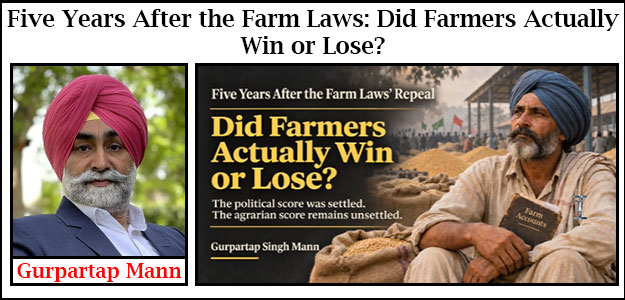
Five Years After the Farm Laws: Did Farmers Actually Win or Lose?
Los Angeles/ Nov 20, 2026
NRIpress.club/Ramesh/ A.Gary Singh
The three farm laws were repealed. On the birth anniversary of Shri Guru
Nanak, the Prime Minister appeared on TV and announced the decision.
Five years later, as the anniversary approaches, one hard question must be asked — a question
rarely raised during the agitation and still avoided today: what exactly did the farmers gain from the
repeal?
The laws were not sudden inventions. For nearly forty years, serious voices in agriculture had
demanded that farmers be freed from the monopoly of the APMC mandi system, allowed to sell
where they got better prices, and given a clear legal framework for contract farming. Industry was
unshackled in 1991. Agriculture stayed chained to old laws. The 2020 laws were an attempt —
maybe not perfect — to begin that long-delayed liberation of farmers. They opened alternative
marketing channels outside the regulated mandis, created a framework for price-assured and safer
contract farming, and eased stock limits so that private investment in storage and logistics could
grow. These were steps towards giving farmers more choices, not fewer, and a real chance to
improve farm economics.
Yet a powerful narrative quickly took hold. The laws were branded “black laws.” Most people who
repeated that phrase had never read them properly. A second fear was layered on top: corporations
would snatch farmers’ land. No such provision ever existed. The laws did not allow forced sale or
transfer of land. This fear was manufactured and then amplified. Who benefited from this fear? The
arhtiyas and the entire ecosystem that thrives on the mandi system. A carefully researched narrative
was built around the farmers’ weaknesses and then weaponised. Comrades, leftists and naxalites
studied those weaknesses and created the story that suited them. One of their favourite traps was
simple and effective: “Corporates will buy from farmers at a good price for one year, then they will stop. What will the farmer do then?” This scare was spread repeatedly to kill any alternative to the
mandi system.
Many of the leaders who led the agitation had their own deep self-interest. Several were themselves
arhtiyas and sheller owners. For them, free sale outside the mandi was a direct threat to their
commissions and business. The movement that began with genuine farmer anxiety was steadily
trapped and steered by comrades and naxalites who have always specialised in obstruction. These
leaders were more interested in their own name glorification than in the long-term prosperity of
farmers. They were more interested in collecting funds and pocketing them than in solving the real
problems of agriculture. The ordinary farmer became a tool for their personal and political gains.
That who did not participate in the agitation was termed a gaddar. That who even dared to discuss
the fine print of the farm laws for argument met the same fate.
Agriculture is a state subject, but the entire economics of trade and commerce falls under the
Centre. This simple constitutional reality was rarely explained honestly. Instead, farmer leaders
repeatedly claimed that the Centre had no business making any law at all. The distinction was
blurred, and the public was misled. Eleven rounds of talks were held. The government offered to
suspend the laws, amend specific clauses, and address concerns. The response remained binary:
accept total repeal or nothing. Negotiation was treated as surrender, and those who tried to reason
were branded traitors. In the end the Prime Minister withdrew the laws and, in effect, apologised for
failing to convince a section of farmers. It was presented as a historic victory of the peasantry over
Delhi.
But what did that victory deliver on the ground?
Five years later, the fundamental indicators for farmers have not improved. Debt continues to rise.
RBI figures show that outstanding agricultural credit from scheduled commercial banks in Punjab
rose from ₹66,375 crore in March 2021 to ₹84,951 crore in March 2025. Real incomes for most
farmers remain under pressure. The shift away from the water-guzzling paddy-wheat cycle has been
dismal. Private investment in alternative marketing, processing and cold chains did not surge
because the legal space for it was shut down. Price crashes in vegetables, potatoes, onions and other
non-MSP crops remain as frequent as before. The APMC-MSP system was protected for those who
sell wheat and paddy in the major government procurement states, but the larger structural
problems of Indian agriculture were left untouched — including the very basis of how MSP is
determined. Yet again this year, a major leader of one BKU faction was heard complaining that
farmers are being looted in the mandis and are getting less than MSP for paddy. Farmers are being
looted in the mandis exactly like before. This single complaint exposes the truth. After forcing the
repeal, we went straight back to the same old monopolistic government procurement system. That
system is squeezing farmers today exactly the way it has been squeezing them for the last forty
years.
No one questioned the way MSP is fixed. Nobody questioned the working of the CACP. Nobody
questioned the National Food Security Act and the heavy cost of government procurement to feed
the poor at the expense of farmers. None asked why draconian laws like the Essential Commodities Act still exist. None demanded agro-based industries in Punjab to create value addition after harvest.
History may one day record this episode as a political triumph — the moment when organised
farmer power forced a strong government to retreat. That reading is incomplete. A more accurate
verdict is tha a rare opportunity for reform was sacrificed to protect deeply entrenched interests.
The arhtiyas retained their commissions. The political class retained its patronage networks. Leftist
obstructionism, which had earlier driven industry out of certain states, found a new space in agriculture. They simply changed the colour of the flag from red to green, keeping their core
ideology intact. The ordinary farmer was left with the same economic and financial constraints, the
same risks, and the same limited options.
Future generations will ask a simple question: when the chance finally came to free agriculture the
way industry was freed in 1991, why was it rejected? If the only answer we can give is that we
brought Modi to his knees, then we must also admit that we failed to bring prosperity to the
farmers. In that sense, the movement did not merely defend the peasantry. In important ways, it
cheated them. A few leaders gained followers, a few YouTube channels gained TRP, and a few
individuals became richer — all at the cost of farmers’ long-term welfare.
The laws may not have been perfect. But they could have been improved through negotiation. Even
the Constitution has 108 amendments. The fear of corporate power was so exaggerated that it
scared investment away from the state. The complete rejection of reform, the refusal to separate
genuine safeguards from the protection of middlemen, and the elevation of political symbolism over
long-term economic interest have left Indian agriculture poorer in options than it needed to be. Five
years on, that is the real balance sheet.
The political score was settled. But the agrarian score remains still the same and unsettled.

|