FBI Accuses Local Punjab SHO in $400,000 Extortion Bid as organised crime: Punjab’s
Gangster Raj Stands Exposed
Operation Hard Ball Is A Wake-Up Call For AAP
Los Angeles/ July 09, 2026
NRIpress.club/Ramesh/ A.Gary Singh
Punjab did not need the FBI to know that its gangsters operate from abroad and from jails.
Every trader, transporter, builder, NRI family and small businessman knows this bitter truth.
Extortion calls come from foreign numbers. Threats are issued from jails. Shootings are
arranged locally. Money is collected silently. Fear travels faster than the police.
What is new, and far more shameful, is that the FBI and the United States Department of
Justice have now placed Punjab’s gangster ecosystem inside an international organised-crime
investigation.
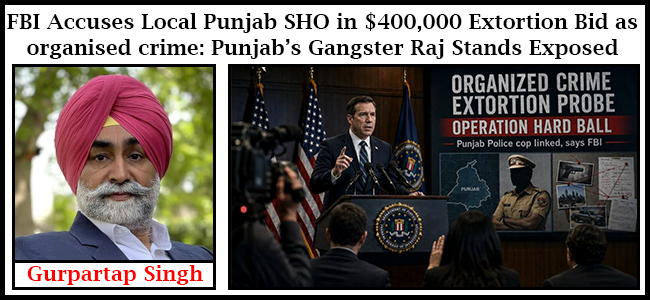
The Tribune has reported that the FBI has accused local Punjab Police SHO Gurinderjit
Singh Nagra of being linked to an alleged $400,000 extortion attempt against a family in the
United States. The allegation is part of Operation Hard Ball, a major US-led crackdown on
India-linked transnational organised crime groups.
This is not a small news!
What is Operation Hard Ball?
In simple words, it is an FBI and US Department of Justice operation against India-linked
gangs operating across the US, Canada and Europe. It has led to 24 arrests and three
indictments against 37 accused persons, allegedly linked to organised-crime networks
involved in extortion, shootings, drugs, firearms and targeted killings. The DOJ says cocaine,
heroin, cash and weapons were also seized.
Let one legal caveat be stated clearly. An indictment is an allegation, not a conviction. Every
accused is presumed innocent until proven guilty. But governance cannot hide behind
courtroom technicalities. When a local Punjab SHO is named in connection with an
international organised-crime probe, it is not merely a legal issue. It is a political and
administrative indictment.
This is not ordinary crime. This is organised crime. And organised crime does not survive on
guns alone. It survives on police leaks, political shelter, jail networks, money channels, local
fear and administrative silence.
The real question is unavoidable: can such organised crime happen without political or
administrative protection?
This must not be dismissed as opposition rhetoric. It is now a governance question. If
gangsters sitting in jails or abroad can direct extortion, arrange shooters, threaten families,
influence local cases and build overseas networks, then someone inside the system is
enabling them. Someone is looking away. Someone is protecting them. Someone is earning
from fear.
Punjab knows what is happening. Extortion rackets, firing incidents, killings and threats have
become routine. The level of fear is now so high that many people do not even lodge
complaints. The fear is simple: after complaint, they may become the next target. Worse, the
common whisper across the state is that victims are sometimes advised, “Koi na, je 50 lakh
mangde ne, ta 25 lakh de ke kam khatam karo.” If this is how people feel about the system,
then the crisis is not only of crime. It is a collapse of State authority.
AAP has done welfare politics aggressively. Free power, mohalla clinics, schools, sarpanch
honorarium and women-centric schemes have created a political narrative. These people-
centric measures cannot be dismissed. They matter. They touch households.
But I had written way back in December 2025 that law and order would become the Achilles
heel of the AAP government in Punjab. Today, this FBI-linked news has proved that warning
brutally correct.
Freebies cannot compensate for fear. Welfare cannot compensate for extortion. A
government may win applause for subsidies, but it loses moral authority if citizens believe
that gangsters are stronger than the State.
The government often points to arrests, encounters and anti-gangster operations. But the real
issue is no longer how many boys were arrested. The real issue is: who protects the network?
Punjab does not merely need arrests. Punjab needs a clean-up.
The State must order a time-bound independent probe into the Punjab link of Operation Hard
Ball. The inquiry must not stop at one SHO of Punjab Police. It must examine police
postings, jail access, mobile phone use in prisons, call records, political links, money trails,
benami properties and protection networks. Punjab Police Officers who help gangsters must
be dismissed and prosecuted. Politicians, middlemen and police personnel who acted as
shields must be exposed.
This is also why the current debate around the film Satluj is relevant. The film has reopened
memories of Punjab’s dark phase and was removed from ZEE5 in India soon after release.
History cannot be banned. But history must also not be repeated.
What has changed from 1995 to 2026?
The Punjab of 1995 was a Punjab of fear, silence, extortion, police excesses, militant violence
and broken trust between citizen and State. Today’s Punjab is the same. Once fear enters
homes, once people stop trusting police stations, once criminals begin using the State
machinery itself as a weapon, the slide becomes frightening. If an SHO is an extortionist,
who will people approach for justice?
This is a wake-up call for the government and the police leadership. Clean up, or the shame
will be remembered like the shame of the 1995 era.

|